
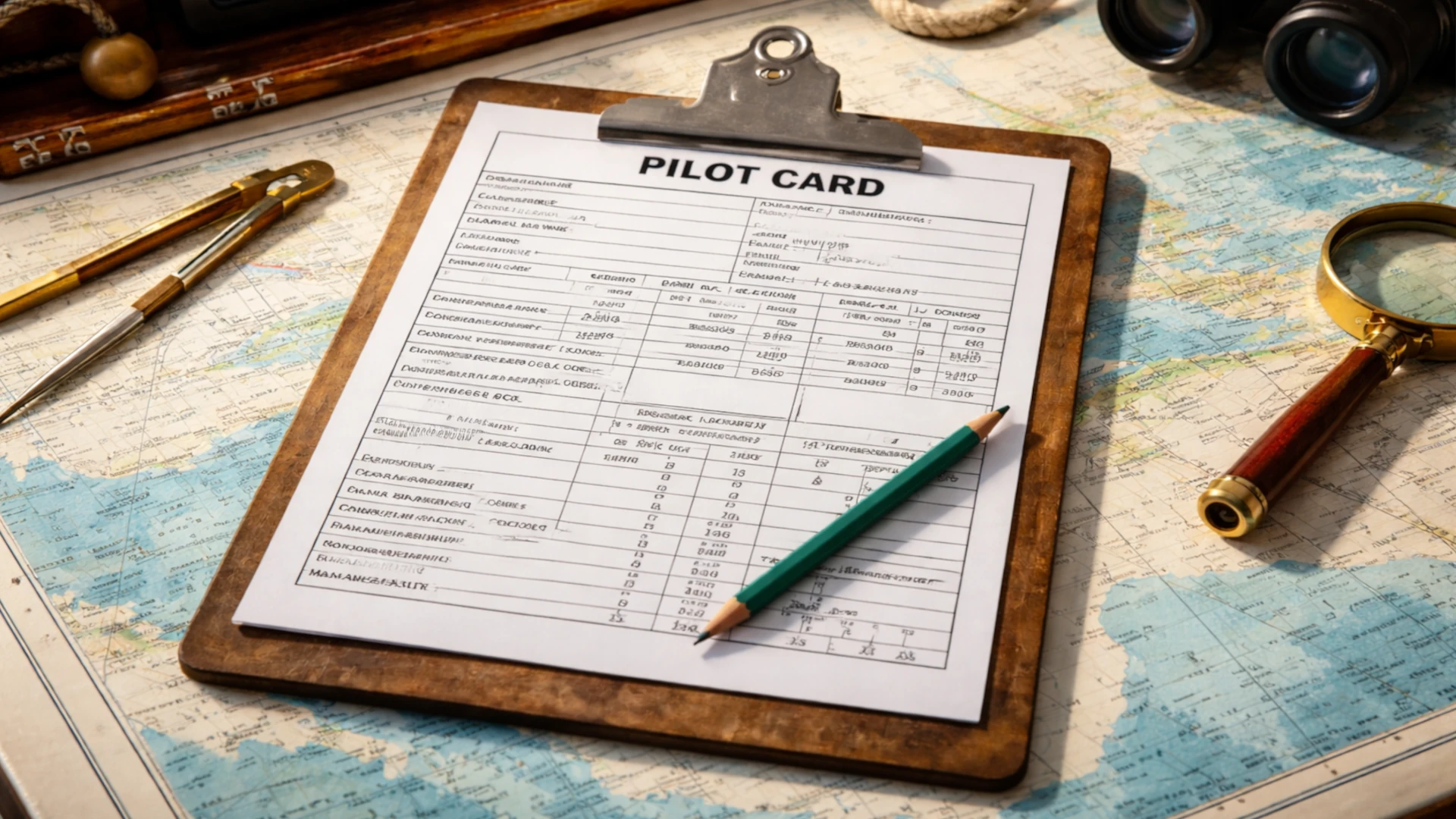
Pilot Card for VDR Reconstruction
Kym Hughes
29 Jan 2026
During normal operation, the Pilot Card facilitates an efficient exchange of information between the vessel’s master and a pilot. It is one of three documents containing manoeuvring information that large commercial vessels are required to carry, along with the Manoeuvring Booklet and the Wheelhouse Poster.
Typically completed immediately prior to pilotage, a Pilot Card should include information about:
- The present loading condition, including the vessel draft;
- Propulsion and manoeuvring equipment;
- Navigation equipment;
- Any defects or limitations which may affect the ship’s manoeuvrability, such as an inoperative bow thruster.
Most vessels maintain a standard card pre-filled with static data, with other variables such as current drafts and gyro error updated before each manoeuvre. This keeps the operation efficient for the crew, and minimises the chance of passing incorrect information to a pilot.
Relevance for Digital Reconstructions
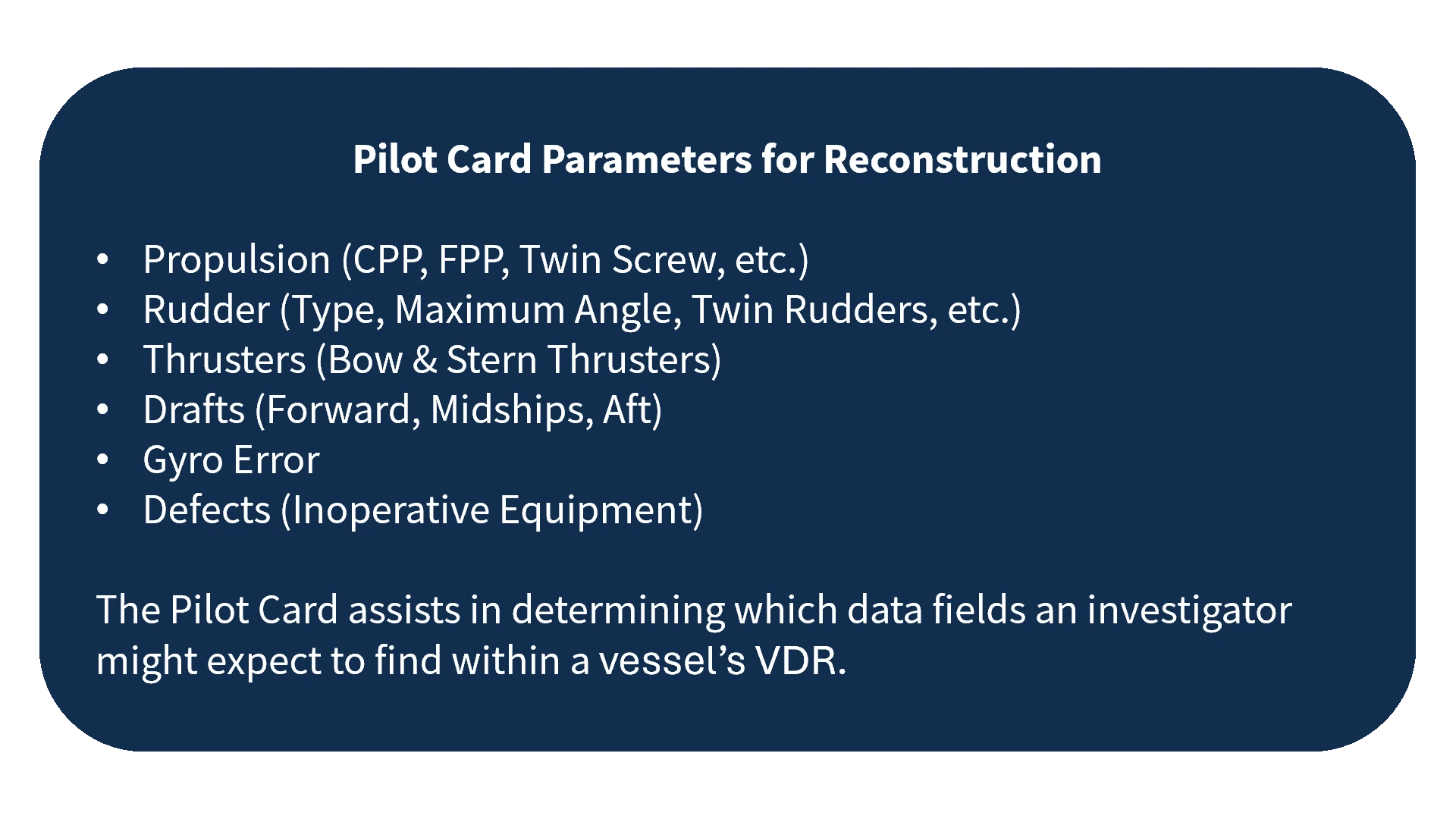
Given the key data contained on a Pilot Card, its use in post-incident investigations and analysis by experts is clear. Particularly if an incident has occurred under pilotage, it will provide vital evidence of the data that was made available to the pilot upon boarding. In terms of digital investigation and reconstruction, however, the Pilot Card serves another purpose. It acts as a technical roadmap of the ship’s manoeuvring capabilities, helping digital evidence specialists to determine:
- What data should exist in the VDR;
- What types of systems are present onboard;
- What data may be missing from a default data extraction.
VDR manufacturers provide software for the extraction and presentation of data from the VDR onboard a vessel, however, it is not uncommon for additional data fields to be present which may not be shown by the manufacturer provided software.
For example, a vessel may have a controllable-pitch propeller, but the manufacturer’s software might be configured to only show the propeller RPM. Although RPM is useful, of more interest in this situation would be the pitch of the propeller blades.
The Pilot Card highlights this sort of information, making it an ideal reference for digital evidence specialists extracting data, helping to guide them towards potential extra data hidden within a raw or proprietary channel.
Without A Pilot Card
Without a pilot card, ambiguity is introduced into the reconstruction process. For example, if your dataset did not include bow thruster data, which of the following statements would be true?
- The vessel does not have a bow thruster.
- The vessel has a bow thruster, but the VDR was not configured to record the data.
- The vessel has a bow thruster, the VDR did record the data, but it is stored in a proprietary format which requires manual extraction.
Without a Pilot Card for reference, the reconstruction could be incomplete without anyone realising there is missing data.
Secondary techniques are available, however, none are as reliable as the Pilot Card.
You could look at images of the vessel to see whether there are any markings on the hull, but that only works for machinery which actually requires hull markings.
Similarly, you could listen to the VDR audio to determine whether the speech references any equipment from which you may have data, but that only works if the specific equipment is spoken about.
A third technique is analysing the VDR configuration files, which should describe all the data sources feeding the VDR, however it often references manufacturers and model numbers, rather than describing the navigational function of the equipment.
The Pilot Card helps to eliminate this guesswork. It clearly shows the manoeuvring equipment available, and flags any equipment that might be inoperative at the time of an incident.
Even if the vessel was not under pilotage at the time of an incident, the most recent Pilot Card will assist in the reconstruction.
The Pilot Card is a vital piece of supplementary evidence. It helps to ensure that the digital evidence extracted from a VDR is complete, contextually accurate, and aligned with the real characteristics of the ship.